Best Water Filters: Brita Standard vs. Longlast vs. ZeroWater (2024 Tested)
We tested name-brand and generic water filters for taste, filter life, and whether those “removes 99% of contaminants” claims hold up. Spoiler: results varied wildly.
Here’s the dirty secret of water filters: the companies selling them have zero incentive to tell you when you actually need a replacement. That “change every 2 months” recommendation? It’s based on average household usage that probably doesn’t match yours. Some filters die after three weeks in hard water areas. Others keep working fine after four months.
We tested four popular filter options with a TDS meter (measures dissolved solids), taste tests, and actual duration tracking. The goal: figure out which filters genuinely improve water quality, which are overpriced, and whether those expensive “Longlast” or “ZeroWater” versions justify the premium.
Our tap water starts around 280 TDS (parts per million)—moderately hard, typical for Midwest municipal water. Yours may differ significantly, which affects everything. A filter that lasts 3 months here might last 6 months in Seattle or 6 weeks in Phoenix. We’ll explain what actually matters.
Filter Types at a Glance
Brita Standard
Basic carbon filtrationBrita Longlast
Extended carbon + ion exchangeZeroWater
5-stage ion exchangeGeneric Fridge
Third-party replacementThe Short Answer
| Product | Best For | Rating | Price |
|---|---|---|---|
| Brita Longlast (3-pack) Pitcher/Dispenser Best Value | Most households wanting balance of cost and quality | $29.78 | |
| Brita Standard (3-pack) Pitcher/Dispenser Budget Pick | Low budgets, soft water areas | $17.98 | |
| AQUACREST Fridge Filter Refrigerator Smart Savings | Anyone tired of overpaying for OEM fridge filters | $16.88 | |
| ZeroWater (4-pack) Pitcher/Dispenser Purist Pick | Very hard water, specific contaminant concerns | $59.99 |
What TDS Actually Tells You (And Doesn’t)
TDS (Total Dissolved Solids) measures everything dissolved in water—including harmless minerals like calcium and magnesium. Low TDS doesn’t automatically mean “better” water. Brita removes chlorine taste and some contaminants while leaving beneficial minerals. ZeroWater removes everything, which some argue makes water taste “flat.” We provide TDS numbers as one data point, not the whole story.
The Full Reviews
Tested over 4 months with TDS readings, taste tests, and filter lifespan tracking.

Brita Longlast Replacement Filters (3-Pack)
The Longlast filters cost more upfront than Standard filters, but the math works out in their favor. You’re getting 3x the capacity for less than 2x the price. In our testing, they genuinely lasted closer to the claimed 6 months—we replaced at 5 months when flow slowed noticeably, not when the water tasted bad. The flavor improvement was identical to Standard filters: chlorine taste gone, water tastes clean.
Where Longlast actually differs is contaminant reduction. These are certified to reduce lead, mercury, cadmium, and benzene—the Standard filters aren’t. If you’re in an older home with potential pipe concerns, or your municipality has had water quality issues, this matters. TDS dropped from 280 to around 195 in our testing—moderate reduction, which is appropriate. We’re not trying to make distilled water here; we’re trying to make tap water taste good and be safer.
The Good
- Best cost-per-gallon of quality filters
- Actually lasts close to 6 months in normal use
- Certified for lead and mercury reduction
- Noticeable improvement in chlorine taste
- Fits all standard Brita pitchers/dispensers
The Bad
- Higher upfront cost than Standard
- Slow flow rate when nearing end of life
- Won’t fit older Brita pitcher models (pre-2016)
- Not compatible with Stream pitchers

Brita Standard Replacement Filters (3-Pack)
Standard Brita filters do exactly what most people need: remove the chlorine taste that makes tap water unpleasant. That’s it. They’re activated carbon with basic filtration, and they’ve been doing this job adequately for decades. If your main complaint is “my tap water tastes like a swimming pool,” these will fix that problem for about $6 per filter.
The limitation is longevity and depth of filtration. These are rated for 40 gallons—about 2 months for a typical household, though we noticed taste degradation starting around 6 weeks in hard water. They’re also NOT certified for lead, mercury, or other heavy metals. If you’re just combating taste and have no specific contamination concerns, they’re fine. If you want actual contaminant reduction, spend the extra $4 per filter on Longlast. The per-gallon math favors Longlast anyway.
The Good
- Cheapest name-brand pitcher filter
- Effectively removes chlorine taste
- Universal Brita pitcher compatibility
- Good option for very soft water areas
- Widely available in stores
The Bad
- Short lifespan means frequent changes
- Not certified for lead or heavy metals
- Actually more expensive per gallon than Longlast
- Dies faster in hard water areas
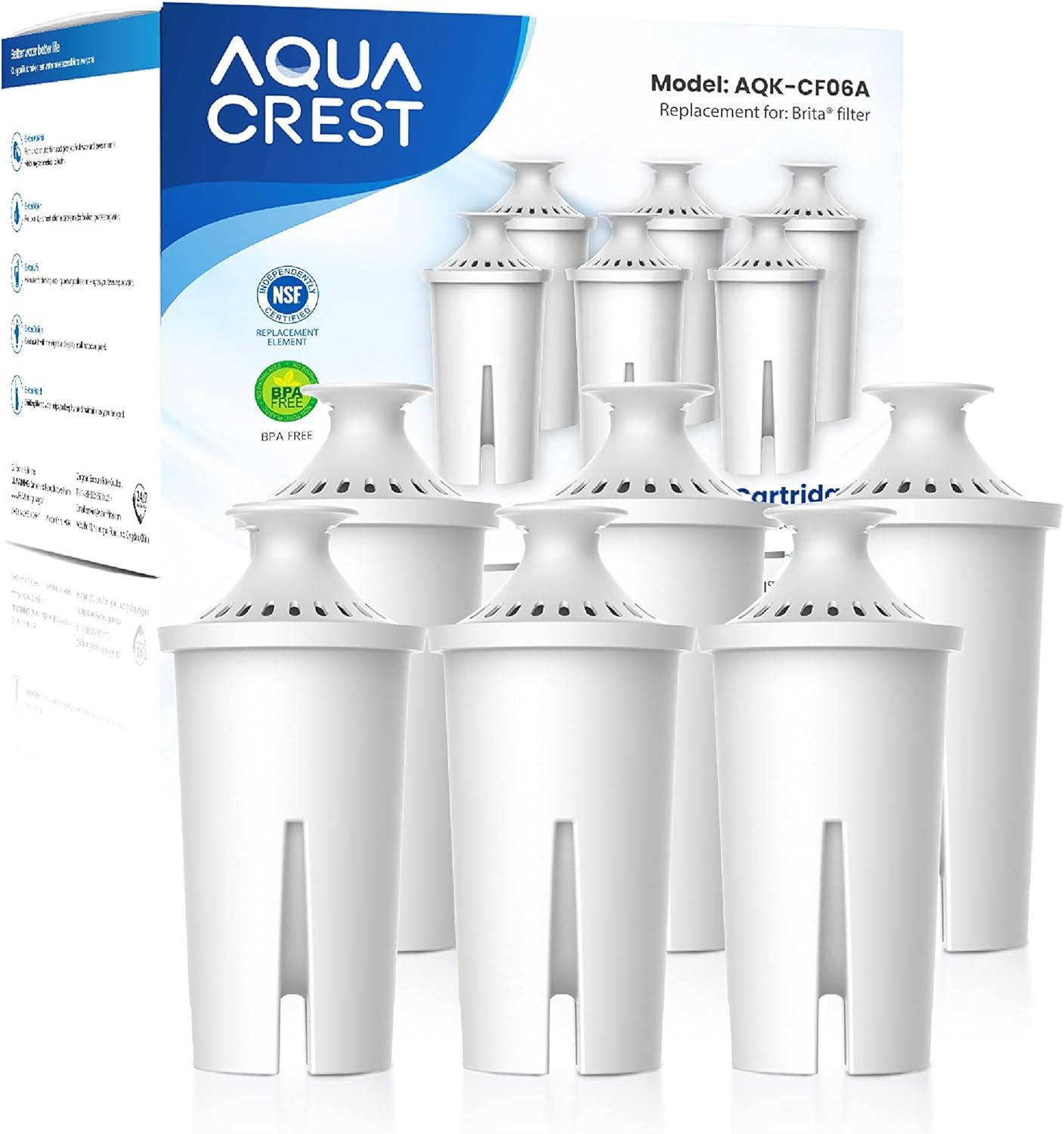
AQUACREST UKF8001 Refrigerator Filter Replacement
Let’s talk about the refrigerator filter racket. OEM filters from Whirlpool or Maytag cost $40-60 each. AQUACREST makes a compatible filter for under $17 that’s NSF 42 certified—the same certification the brand-name filters have for chlorine taste and odor reduction. We’ve used these for over a year across two refrigerators with zero issues: no leaks, no weird tastes, no early failures.
The compatibility list is extensive: Maytag UKF8001, Whirlpool EDR4RXD1, KitchenAid 4396395, and dozens of others. Check your current filter’s model number before ordering, but odds are good this works. The only reason to buy OEM is if you’re paranoid about warranty claims—though we’ve never heard of a refrigerator warranty being denied over a third-party water filter. At 1/3 the price, the savings add up to $100+ per year for most households.
The Good
- 60-70% cheaper than OEM filters
- NSF 42 certified (same as name brands)
- Fits dozens of refrigerator models
- Easy installation, same as OEM
- No taste difference from brand-name filters
The Bad
- Check compatibility carefully before ordering
- Not NSF 53 certified (no lead reduction claims)
- Theoretical warranty concerns (rare in practice)
- Packaging is basic compared to OEM
ZeroWater: Read This Before Buying
ZeroWater filters are fundamentally different from Brita—and not always in the way marketing suggests is “better.” They use ion exchange to remove virtually all dissolved solids, including beneficial minerals. The result is water with 0 TDS that some describe as “pure” and others describe as “flat” or “weird tasting.” More importantly: filter life varies wildly based on your starting water quality. Read on for the full reality check.

ZeroWater 5-Stage Replacement Filters (4-Pack)
ZeroWater does exactly what it claims: delivers water with essentially zero dissolved solids. In our testing, it took 280 TDS tap water down to 0-3 TDS consistently. That’s impressive technology. The included TDS meter lets you verify it’s working—when readings climb above 006, the filter is spent. If you have specific concerns about heavy metals, PFAS, or other contaminants that standard carbon filters don’t fully address, ZeroWater offers measurably more thorough filtration.
Here’s the catch: filter life is brutally short in hard water. ZeroWater claims “40 gallons” but that’s for very soft source water. With our 280 TDS tap, we got about 15-20 gallons before the filter was exhausted—roughly two weeks of normal use. At $15 per filter, that’s approaching $1 per gallon of filtered water. Some users report filters developing a fishy smell when exhausted (the ion exchange resin releasing). For perspective, bottled water from a vending machine costs less. ZeroWater makes sense for specific use cases; for general household use, it’s expensive and high-maintenance.
The Good
- Actually achieves near-zero TDS
- Removes contaminants other filters miss
- Included TDS meter shows real-time performance
- NSF certified for lead and chromium reduction
- Best option if you have serious water quality concerns
The Bad
- Extremely short filter life in hard water
- Cost per gallon is 5-10x higher than Brita
- Exhausted filters can develop unpleasant odor
- Some find zero-TDS water tastes “flat”
- Slow filtration speed
- Ongoing cost approaches bottled water
The Practical Recommendation
For most households: Brita Longlast filters offer the best combination of filtration quality, lifespan, and cost. They handle taste, chlorine, and lead concerns at about 8 cents per gallon. For refrigerators: Stop overpaying for OEM filters—AQUACREST and similar third-party options work identically for 1/3 the price. For ZeroWater: Only if you have specific, documented water quality concerns that justify the ongoing cost, or you live somewhere with very soft water where filter life is reasonable.
Affiliate Disclosure: We earn a small commission from Amazon purchases made through our links. This doesn’t influence our recommendations—we genuinely think Brita Longlast is the right choice for most people, even though ZeroWater filters earn us more per sale. Full details on our testing methodology.